Is 5 hours of screen time a day bad? What 3–12 hours really means
Is 5 hours of screen time bad? 5 hours a day is 76 days a year. See every level from 3 to 12 hours, how you compare, and what to do at yours.
The weekly report lands on a Sunday morning: Daily average 5h 12m. You’d have guessed two, maybe three. Now you’re wondering whether that’s normal, bad, or something you need to worry about.
Short answer: For an adult, 5 hours a day of leisure screen time is a lot, but it’s not a diagnosis. It works out to about 76 days a year and nearly a third of your waking hours. That’s slightly above the UK average for all time online. What matters more than the number is what it pushes out: sleep, focus, people, the things you said you’d do.
What your daily screen time adds up to
Hours a day feel small. Hours a year don’t. Here’s every level from 3 to 12 hours, assuming a 16-hour waking day. The last column shows how many full 24-hour years it adds up to by age 80 for someone who’s 30 now (50 more years at the same pace).
| Daily screen time | Hours per year | Full days per year | Share of a 16-hour waking day | Years by age 80 (from 30) |
|---|---|---|---|---|
| 3 hours | 1,095 | 46 | 19% | 6.3 |
| 4 hours | 1,460 | 61 | 25% | 8.3 |
| 5 hours | 1,825 | 76 | 31% | 10.4 |
| 6 hours | 2,190 | 91 | 38% | 12.5 |
| 7 hours | 2,555 | 106 | 44% | 14.6 |
| 8 hours | 2,920 | 122 | 50% | 16.7 |
| 9 hours | 3,285 | 137 | 56% | 18.8 |
| 10 hours | 3,650 | 152 | 63% | 20.8 |
| 11 hours | 4,015 | 167 | 69% | 22.9 |
| 12 hours | 4,380 | 183 | 75% | 25.0 |
At 5 hours, you spend about two and a half months a year looking at a screen, around the clock. Counted in waking hours only, it’s about 15.6 of your next 50 waking years.
Two honest caveats. First, these are straight-line projections. Real habits change with age, jobs and kids. Second, not all screen time is lost time. A video call with your mom, a map in a new city, and an hour of reading are all screen time. To run your own number, including what you’d get back by cutting an hour, try the screen time calculator.
68
days a year
10.4
years by age 80
28%
of your waking day
Assumes 16 waking hours a day and the same habit until 80. It counts all phone time — some of it is time well spent. Bricked is for the rest.
How do you compare to the average adult?
The best current figures come from three sources, and each measures something slightly different.
- UK, measured: Adults spend an average of four and a half hours online a day, up 10 minutes on the year before, according to Ofcom’s Online Nation 2025. That covers phone, tablet and computer, and Ofcom says most of it happens on a smartphone. Women average 4 hours 43 minutes, 26 minutes more than men.
- Global, survey-based: The typical online adult spends well over 2.5 hours a day on social and video platforms, which is roughly 16% of their waking hours, according to DataReportal’s Digital 2026 report. The same report puts all online media at about 33.5 hours a week.
- US, how people feel: 53% of American adults say they spend too much time on their smartphone, rising to 70% of 18- to 29-year-olds and 64% of 30- to 49-year-olds (Pew Research Center, 2026). And 26% say they’re on it “almost constantly.”
So if your iPhone shows 5 hours, you’re a bit above a typical UK adult’s total online time, and that’s on one device. Your laptop and TV come on top.
4.5 h
a day online for the average UK adult, across phone, tablet and computer
4 h 43 min
a day for UK women, 26 minutes more than men
+10 min
up on the year before
How to see your real number on iPhone
Your iPhone’s number only counts your iPhone (plus your iPad and Mac if Share Across Devices is on).
- iOS 27: Go to Settings > Screen Time > Daily Average, then tap Week or Day (Apple Support).
- iOS 26: Go to Settings > Screen Time > See All App & Website Activity.
Then do the one thing that makes the number useful: split it. Add up work apps, maps, calls, music and podcasts with the screen off, and reading. Subtract that from your total. What’s left, mostly social, video and games, is the number to work on. It’s usually the part you didn’t plan.
What research links heavy screen time to
Most studies on screen time and wellbeing are correlational. They show that two things go together, not that one causes the other. People who feel low may scroll more, rather than the other way around. With that in mind, here’s what the better evidence says.
Sleep is the clearest link. In a large survey of Norwegian students, each extra hour of screen use after going to bed was associated with 59% higher odds of insomnia symptoms and about 24 minutes less sleep (Hjetland et al., 2025). Social media wasn’t linked more strongly than other screen activities. The association was with time on a screen in bed, whatever you were doing. In Pew’s 2026 survey, 41% of US adults said their smartphone hurts their sleep, and only 5% said it helps.
Problematic use, not just heavy use. A King’s College London study of 1,043 students aged 18 to 30 found that those who scored high on a smartphone addiction scale were more likely to report poor sleep, 68.7% versus 57.1% (Sohn et al., 2021). That scale is a screening tool, not a diagnosis. It measures loss of control, not hours.
Focus and mood, as people report it. In the Pew survey, 34% of adults said their phone hurts their productivity and 22% said it hurts their mood. Among 18- to 29-year-olds, it was 49% and 31%. These are people’s own judgments, not lab measurements, but they’re worth taking seriously.
41%
of US adults say their smartphone hurts their sleep
34%
say it hurts their productivity
22%
say it hurts their mood
Cutting back seems to help. Here the evidence is experimental, which is stronger.
- In a German trial with 619 people, using the phone one hour less a day for a week was followed by higher life satisfaction and fewer symptoms of depression and anxiety. The effects were still there four months later (Brailovskaia et al., 2022). People didn’t have to quit, only cut back.
- In a pre-registered trial, blocking mobile internet on people’s phones for two weeks improved sustained attention, mental health and wellbeing on average (Castelo et al., 2025). That’s more drastic than most people want, but it shows the direction.
What the research doesn’t support: a magic line, like “over 5 hours causes depression.” No credible study shows that, and you should be suspicious of anyone who claims it.
Is it an addiction?
No number of hours makes it one. Phone “addiction” isn’t a formal diagnosis. When researchers measure problematic phone use, they ask about things like failing to cut back, losing sleep, and using the phone despite wanting to stop, not hours.
A quicker gut check: do you open apps you didn’t decide to open? Do you lose time you can’t account for? Do you feel worse afterward and do it again anyway? Our phone addiction test walks through these questions in a couple of minutes.
If your phone use is seriously affecting your sleep, work, relationships or mood, talk to a doctor or mental health professional. That isn’t a failure. It’s the right tool for the job.
What to do at each level
Assume these are leisure hours on your phone, after you’ve subtracted work and the genuinely useful stuff.
Under 3 hours: keep it honest
You’re below most averages. Turn off non-essential notifications and keep the phone out of the bedroom. Check your weekly report once a week, not daily. That’s it.
3 to 5 hours: pick your two worst apps
Often one or two apps account for most of it. Give those a daily limit about 30 to 50% below your current average, and add a bedtime schedule so the last hour of the night is off-limits. Expect the first week to feel annoying. That’s the limit working.
5 to 7 hours: add friction, not just limits
At this level, a limit you can skip in one tap won’t hold. It’s easy to end up tapping “Ignore Limit” on autopilot (here’s why that happens and how to fix it). Set limits that cost something to bypass: a passcode someone else holds, or a blocker with a wait or hold before each unlock. Add a schedule for your worst hours. For many people, that’s late evening.
7 to 9 hours: protect sleep first
Start with the hour before bed and the first hour after waking. A hard bedtime block and a charger outside the bedroom will usually recover more than any willpower plan. Then step limits down by 15 to 30 minutes a week, not all at once. The German trial suggests an hour less a day is already a meaningful change.
9 hours or more: get structure and support
If most of that is leisure, it’s worth treating as more than a habit tweak. Use every structural tool you have: app limits, schedules, someone else holding your Screen Time passcode, and a phone-free room. If it’s hurting your work, sleep or relationships, talk to a professional. Also check whether work or study apps are inflating the number, because that changes the plan completely.
How Bricked fits in
If you’re in the 5-hour-plus range and keep beating your own limits, that’s the moment Bricked was designed for. You pick your apps and a daily limit, and your use visibly fills a glass brick with clay on the Home screen. When the time’s up, Apple’s shield covers those apps until midnight. They turn to brick.
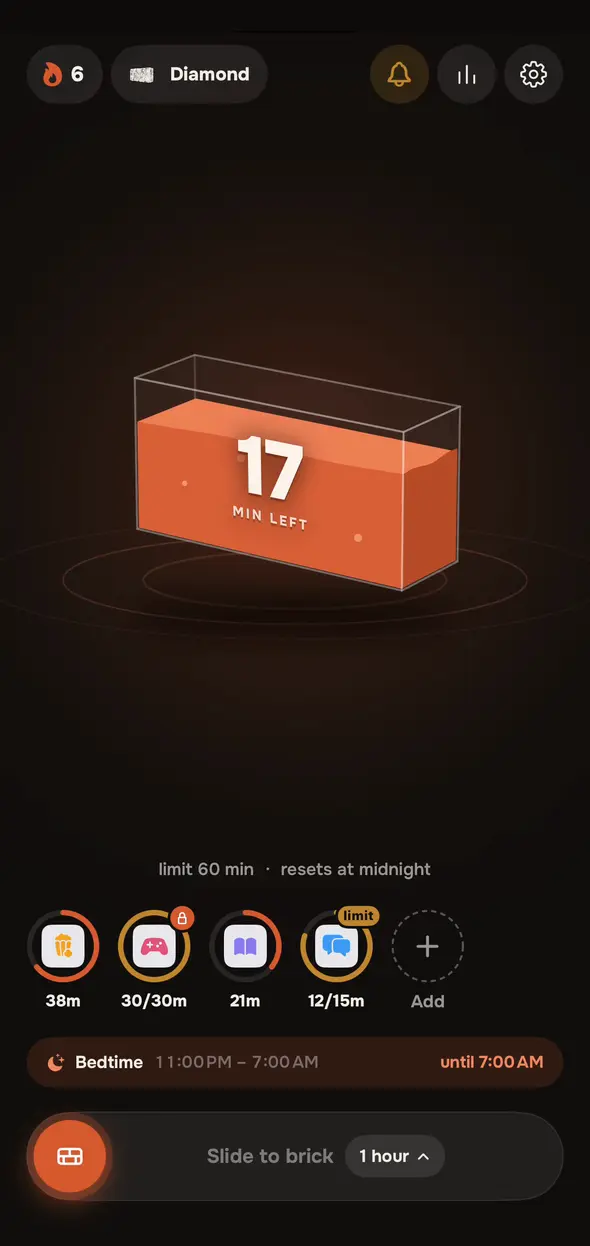
There’s no one-tap “Ignore Limit.” Every unlock is a 5-minute peek. On the free plan, you wait longer each time (none, 30 seconds, 1 minute, 3 minutes, then 5). On Bricked+, you press and hold, from 3 seconds up to 60. Schedules like bedtime brick your apps automatically, even if you have minutes left. It’s honest about its limits, too: you can raise your limit or delete the app, and it blocks whole apps, not just Reels or Shorts. Your limits, schedules and stats stay on your phone, and there’s no account to create.
The bottom line
Five hours a day isn’t a medical red line. But it is 76 days a year, and most people who see that number didn’t choose it. Subtract the useful hours, find the one or two apps behind the rest, and put friction exactly where you lose control. For a step-by-step setup, see how to lock yourself out of apps on iPhone.
Questions people ask
Is 5 hours of screen time a lot?
For leisure use on a phone, yes. It's about 76 days a year and nearly a third of a 16-hour waking day. It's a bit above the UK adult average for all time online, which Ofcom puts at about 4.5 hours a day across phone, tablet and computer. If a big part of it is work, calls or navigation, the picture is different.
How many hours of screen time is considered an addiction?
None. There's no hour count that turns heavy use into an addiction, and phone 'addiction' isn't a formal diagnosis. Researchers use questionnaires about loss of control and harm to daily life, not hours. If your phone use is seriously affecting your sleep, work, relationships or mood, talk to a doctor or a mental health professional.
How much screen time is healthy for adults?
There's no official daily limit for adults. Most guidance for adults is about what screens push out, like sleep, movement and time with people, not a number. A practical test is whether your leisure screen time matches what you'd choose on a calm day. Pick a target for leisure phone time that you'd sign off on at 10 a.m., then make it hold at 10 p.m.
What is the average screen time for adults?
In the UK, Ofcom measured an average of 4.5 hours a day online in 2025, across phones, tablets and computers, with most of it on smartphones. DataReportal's 2026 report says the typical online adult spends well over 2.5 hours a day on social and video platforms alone. Numbers vary a lot by age and by how they're measured.
Is 8 hours of screen time bad?
Eight hours a day is half of a 16-hour waking day and about 122 days a year. If most of it is leisure on your phone, it almost certainly crowds out sleep, movement or people. Start with a scheduled bedtime block and hard limits on your two most-used apps.
Sources
- Ofcom (Dec 2025): From apps to AI search – how the UK goes online in 2025 (Online Nation)
- Pew Research Center (2026): About half of Americans say they spend too much time on their smartphone
- DataReportal / Kepios (Oct 2025): Digital 2026 Global Overview Report
- Hjetland et al. (2025), Frontiers in Psychiatry: screen use in bed and sleep in students
- Sohn et al. (2021), Frontiers in Psychiatry: problematic smartphone use and sleep quality
- Brailovskaia et al. (2022): one hour less smartphone use a day (Ruhr University Bochum)
- Castelo et al. (2025), Blocking mobile internet on smartphones improves sustained attention, mental health, and subjective well-being. PNAS Nexus 4(2)
- Apple Support (iOS 27): Set up Screen Time for yourself on iPhone
You know the feeling. Make it the last time
Pick the apps that eat your evenings. Set a limit. When it runs out, they turn to brick — and the brick holds.